What Happens When We Design for Multiple Users?
The more users a product tries to satisfy, the harder it becomes to create something that truly stands for anyone.
The Biggest Risk Is Trying to Avoid Risk
Every attempt to reduce risk increases the risk of becoming irrelevant.
Every automotive project starts with uncertainty.
No one knows which product will succeed five years from now. Every major decision excludes alternatives, and every strong direction carries the possibility of failure.
To reduce that risk, projects often expand their audience instead of sharpening it.
Another customer group is added. Another use case is considered. Another requirement finds its way into the briefing. Every addition seems reasonable because it makes the product relevant to more people.
The paradox is that every attempt to reduce risk also removes conviction.
Products gradually become collections of compromises instead of expressions of a clear idea. They become easier to justify inside the organisation, but harder to desire outside of it.
This episode explores why designing for multiple users often feels like the safer decision—and why great products usually begin where organisations become willing to leave something behind.
Key Perspectives
"There's also generally a problem by seeking the safe center."


"The moment you are for everyone, you are for no one. Then you're not a brand anymore. You're just a product."
Strategic Problems Explored In This Episode
Strategic Problems Explored
In This Episode
1 | Risk Reduction Creates Compromise
Trying to satisfy more users feels like reducing risk. In reality, every additional priority weakens the clarity of the product.
2 | Safe Decisions Destroy Desire
Products rarely become average because someone made a bad decision. They become average because every decision avoids excluding anyone.
3 | Brands Stop Leading
When the briefing is driven entirely by customer expectations, competitors and market research, the brand gradually loses its own point of view.
Closing Thought
What if trying to reduce the risk of failure is exactly what causes it?
EPISODE TRANSCRIPT
SEASON 2 | EPISODE 2
What Happens When We Design for Multiple Users?
Felix Kilbertus: So, quick update on the new model. Our customer data shows that for 64% of target buyers, exterior design is a decisive purchasing factor. So despite the cost pressure, there is specific budget for visible high design elements. And this car needs to look exceptional. Our target group is clear, but broad. We need to appeal to successful professionals who want presence and quality. We need to appeal to young families who want space, safety and everyday usability. And we need to appeal to younger design-conscious buyers who want something clean, modern and progressive.
So the brief is simple. Make it practical and emotional. Make it progressive and timeless. And make sure that design delivers on the premium positioning.
Which brings us to today’s question: What happens when we design for multiple users? Wolfgang, what do you think when you hear this sort of a briefing?
Wolfgang Philipp: I think it will address all of these target groups, but it will meet no one. And yes, it’s another car in the market.
Felix Kilbertus: The exercise that we do today, this is of course not a real briefing, but some briefings are quite similar to this. And from a design perspective, you can take certain things out and they’re not completely dissimilar to real briefings. But as you say, the first impression is that it’s very generic. But is that because it’s for multiple users?
Wolfgang Philipp: The reason to design for multiple uses is to save costs, to have one model and then sell as many cars as possible without wasting any money. Then we wonder why we have such low margins in the market because we cannot really create any desire with a product that has such a broad target audience. Even if we just reduce it to two or three personas, if they are this broad, we cannot create real desire or we cannot address one target group specifically and become really relevant to them.
Felix Kilbertus: So you think there’s a certain fallacy in trying to be too broad, killing two birds with one stone, so to speak, but ultimately missing too much anyway.
Wolfgang Philipp: What I read from this briefing is that „our buyers say“. This is a weak brand because when we don’t know what we are about and what we want, we start to ask others. We start to ask focus groups. We start to look what is the competition doing – but we look outside. We basically want to know from them what does it take to become a leader for them.
Because brands are leaders. And what we see with strong brands, they are leaders because they have a strong vision. They are onto something. They want to achieve something. And a briefing like this just conveys there is nothing we want to pursue. We basically ask our followers to show us the way. Where do you want us to lead you?
This doesn’t work in the schoolyard because the cool people in the schoolyard, they never ask, „What do I have to do that you like us?“ And this also doesn’t work in the real world.
Felix Kilbertus: That’s an interesting point. As soon as you ask people why you should be liked, of course, people are like, „Huh? Why? That’s weird. Why do you ask that?“ I think the briefing has some interesting elements, but reading through it myself, I immediately thought of a sort of a premium SUV. But because the brand is not present, the brand doesn’t give you any clues or convictions. It became this sort of generic object that is the generic standard of most automotive projects today, some sort of a crossover, some sort of an SUV.
However, I think to go to the core question, the multiple users: Some of these things seem contradictory and there’s a sort of a balance you need to find between complementary and contradictory. So, for example, if we talk about having three groups of customers, that is not a problem as such. So we can target successful professionals. We can target young families who, of course, have safety and everyday usability stories. And yes, we can also target younger demographics, but it needs to be clearly defined.
Why would they be drawn to this typology? Why are they drawn to our brand or our group in this case? But it’s very important not to bring in obvious contradictions. So, for example, practical and emotional, that can be solved if we define what emotion are we talking about, what sort of practicality. I’m already struggling a little bit more when it says progressive and timeless, because those are, in a certain sense, correlated pairs, but not necessarily „ands“. So if something is truly progressive, it will be impactful and therefore it will become timeless because it solves something really well. But to set out to be timeless is a bit of a fallacy because what time are you referring to? The time that is happening now, the last five years, the next five years, the next 10 years? So progressive, yes, needs work to define. Progressive to whom? Progressive in what sense? But it’s too much of these contradictory pairs in a briefing that usually get you into trouble.
Wolfgang Philipp: It is on the one hand too specific and on the other hand, these words are completely empty and meaningless. So everyone understands something different when it comes to progressive, timeless and the like. And everyone has a picture in mind when they hear these words, but not necessarily the same understanding.
And the longer I work in marketing, the more I struggle with target groups, to be honest. Because I never met a target group. I’ve seen individuals that have their dreams or whatever needs they convey in words or emotions. But these target groups are just a box with features to think of. And because we cannot decide on one need specifically, we just call it a group. And then we put it all in this box and say, this is the target group. It is a tool that can help to create some common denominator.
But what would you do without this briefing? If you didn’t have these words like timeless, progressive, what would you do differently?
Felix Kilbertus: The first thing in my contrarian mind is to do the opposite. When it says, okay, it’s successful professionals. Okay, so we’re not targeting losers who are not employed. Okay, good. It’s young families. Okay, so we’re not targeting old singles. Okay, clear. You can get some clarity out of this, but that’s very simplistic. I think that’s not getting you very far.
I agree with you on the problem of the words. There’s only one word that is worse than progressive, and that word is dynamic, by the way. That’s the nightmare briefing word for any designer because…
Wolfgang Philipp: Make it pretty.
Felix Kilbertus: Pretty and dynamic. Those are the worst. Timeless often means don’t do anything weird. And progressive means, „Oh, surprise us. But I don’t know what sort of surprise we’re expecting.“ So they’re all weak words, I agree with you.
So you need a lot of work into the maturity of the organization, the maturity of the brand teams, the marketing teams, the product people, the designers as well. Ideally, you have clever people really shaping this initial briefing and not out of thin air. So if I had heard that briefing, I probably would have thought, „Yeah, guys, product team, you forgot that we had the meeting this morning. You just invented that at 8.30 last night.“ Of course, nowadays, ChatGPT can do that in five minutes before the meeting. But it’s that sort of unstructured briefing that could drive a designer quite crazy.
Now, that said, I think a good briefing and doing that word well really helps a designer because the other thing that a designer really hates more than a vague briefing is too much freedom. So constraints are in many ways a designer’s friend and knowing who you design for – for many designers not every designer – but for many designers it really helps catalyze and stimulate the discussion and in reviews, in the team with your colleagues, with your boss, with the engineering guys. If you know who the target customer is, it really helps you imagine, go deep into the life of the person and develop features and strong ideas that then really convince entire organizations and ultimately hundreds of thousands of customers.
Wolfgang Philipp: I’m still thinking about the target group and what I said before, because I think it’s still not enough. Today it’s not enough anymore to have someone in mind, because there are 10 other brands who have the same picture in mind, and there are designers going from one OEM to the other, bringing with them their target groups or their ideal customers – and it doesn’t solve the problem of the brand.
Felix Kilbertus: But I think that’s the same problem we also face in soccer or in cinema or in fashion. It’s like the pool of talent is the same. You still need to win the game. You can recruit the best soccer players the best fashion designers but you still need to create that internal climate, that will to compete and I think that’s something that is often underestimated.
You need to build really that people who fight for your brand, who invent that brand. That’s the fun in it in many ways – what can you do as a creative as a creative manager as a creative product planner as a creative marketing person to make a difference? Because it is a market out there, it is a competition, and the competition plays out in volume sold, in premiums extracted, in customers coming back, in brand awareness, and so on. I’m at ease with that situation because everyone uses the same sort of resources.
Wolfgang Philipp: What I thought is interesting when you said that actually there’s a meaning behind these words. So when someone says „progressive“ they actually mean, „Yeah, show us what you can do, but don’t surprise us in a bad way.“ And then you need to know these people, these decision makers, what they like or what they deemed okay in the previous briefings. So you are always in the context of the brand or of the decision makers. These words, they are not in space. They are always in the context. And so there’s so much more to it than just this word and when you’re working for a brand for several years, you know exactly what these words mean.
In this context the idea of the brand becomes even more important. Because yes, you’ve said with the football teams, you have this pool of talent and they are switching teams – but for me this still doesn’t solve the problem of the brand. Because as we’ve said with the leader example, when you want to lead somewhere, you have to have a mission and you only can have this mission if you are aligned – when you are a team. Unless you are – we’ve discussed this with the Tesla example with Elon Musk the last time who is one strong leader who knows what he wants and that’s why Tesla is what Tesla is about, that’s clear – but in a gigantic organization with multiple decision makers, they have to be aligned to convey more than a very small common denominator.
You have to have like-minded decision makers to create a vision that is stronger than just „Let’s make this pretty, please“, or „Let’s make it dynamic and progressive.“
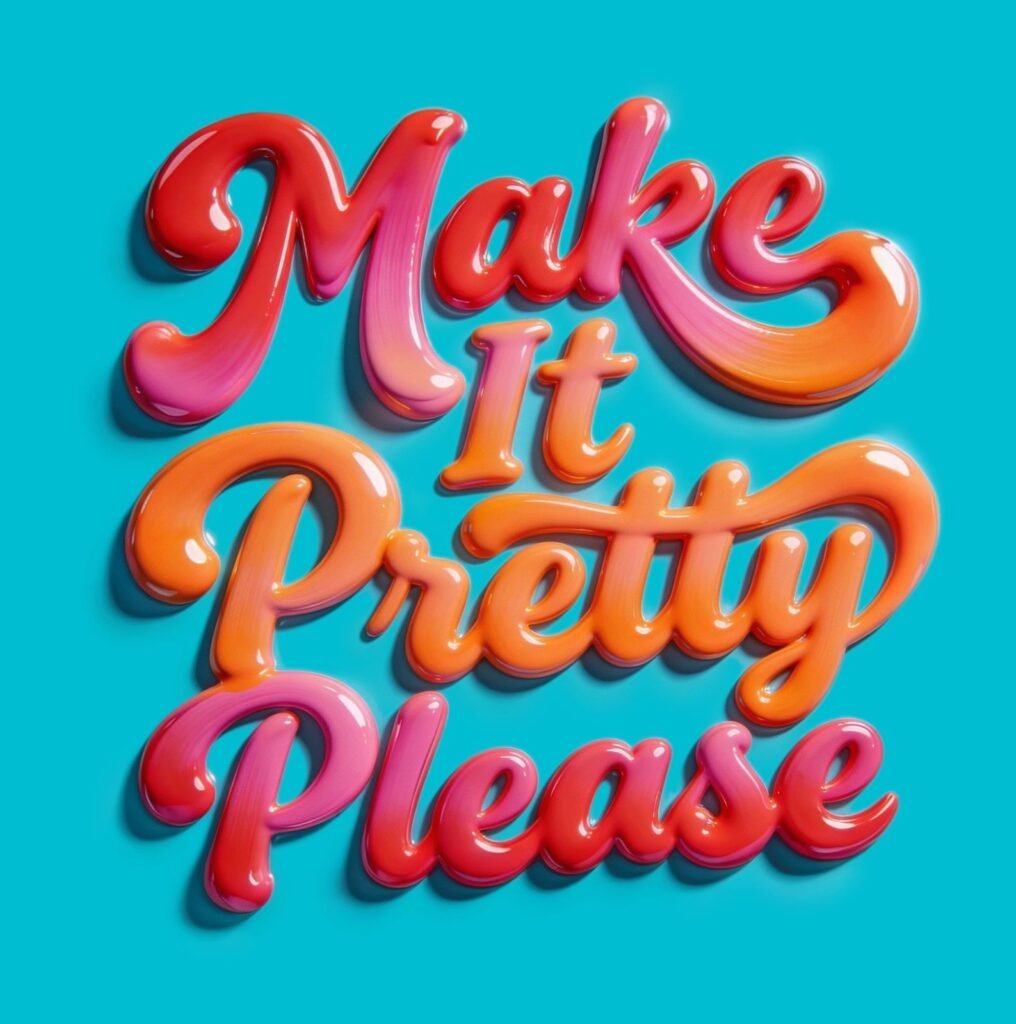
Felix Kilbertus: You’re touching upon some interesting topics there with the meaning behind and who means what. And of course, even the title of the podcast, „Make It Pretty Please“, of course, that expresses a business need: „Make it easy for us to sell.“ That could be a translation of that. „Make it painless for people to look at it.“ But those are such low hygiene factors nowadays. That might have been true in the early industrial age, maybe in the post-war period where there was a scarcity sort of a market. But in our world, this becomes meaningless really quickly.
Now, the problematic of addressing multiple customer groups, you said in the beginning, that can be quite problematic, because you’re basically saving costs by having one product for multiple users. That’s the critical view.
The positive view is, if you select the right people, maybe they have enough common interests and maybe you can unite them into something relatively strong. And I think if you don’t overdo it, then I think you can constructively use that because the likelihood that some people have similar needs in their life in similar life stages is actually quite high. And let’s not forget, people also have common dreams. People have similar needs at specific moments in their life. So that’s per se not a bad thing. It’s the quality of how well you do it.
Wolfgang Philipp: So what is the problem really of designing for multiple users?
Felix Kilbertus: The problem is defining how large and how narrow you want to go. Because on the biggest possible level, you need to decide, is my brand about inclusivity or is my brand about exclusivity? And every brand is somewhere in between these two poles. So you have extremely exclusive brands. And exclusive doesn’t necessarily mean expensive. Exclusive means like I exclude certain people. Therefore, the limited, the niche appeal, the sharp position, the precise position is a value in itself. So that can be something that is relatively cheap, but only very specific people will like it. 90% will hate it, but that’s the point. You’re creating something unique.
Now, inclusive design is a different story. In inclusive design, maybe the purest form is actually UX/UI design that has even legal requirements to be inclusive. So that the biggest number of people can use it reliably. Think of online forms for governments. Think of security of payment. All of these things need to be designed in a way that the largest possible number of people can be brought on board. Now, of course, in the car industry, that is not as pure as that because, of course, you already reduce people that can drive. That is one sharp segmentation already in terms of your driver profiles. It is also people who are mobile enough to actually get into a car. It is also sometimes people who are living in places wealthy enough to have private roads and so on. So it’s not 100% of the population, never. But I think that’s where it starts. Is it an inclusive or is it an exclusive approach in the first place?
Wolfgang Philipp: I would skip the inclusive approach from the very beginning. Inclusivity is very important when it comes to functionality, and I’m fully with you when it comes to user interfaces and those legal requirements we have. But they are a given.
But any brand that has any meaning excludes people. Because the moment you are for everyone, you are for no one, really. And then you are a white label product. And this is not what people are willing to pay any premium for. When it doesn’t matter who is your customer, then you’re not a brand. Sorry, then you’re just a product. And that’s fine. But don’t expect to spark any desire that is above average and create any premium price. This is not happening.
We are in this era where features can no longer differentiate brands. And we can include everyone feature-wise, which we’re doing. We have a very high baseline of the cars, but not from an emotional perspective. The stronger the brand, the more polarizing it is.
This is a good thing. I think this is a complete misconception in our time that we always think this is a bad thing, that the moment somebody says something that not everybody agrees with, this is a bad statement. It’s something that has to be interpreted in some way. But this is not the case, especially not with brands. This is also one of the reasons why most cars are so similar, because they are compromised versions of presumably very strong ideas that have been compromised in hundreds of decisions. And then you have something nobody really disagrees with, but no one really desires.
And the baseline is actually much higher than inclusivity. The baseline for a car to be bought is desire. It’s not, „It’s working, it’s functional, it’s okay, it’s fulfilling my basic needs.“ This is the past. We’re now talking about a much higher baseline – and you cannot achieve this baseline when you try to spark desire for multiple different target groups, whoever they are, by the way, if you don’t have a clear picture in mind what you really want to achieve.
And this brings me back to the schoolyard. Because to me, brands are leaders. And strong brands know what they want, what they are doing. And this is why they spark this desire. This is why people want to follow them. This is why people want to buy their products. This is why people spend overnight in front of an Apple store and freeze outside all night to get the first iPhone. They are not comparing features with other phones and then saying, okay, I’m willing to pay 50 euros extra for this.
Felix Kilbertus: I think when we limit it very consciously to the most mature car markets in the world, I agree with you to a large degree. If we look a little bit wider, I would strongly disagree with you on a couple of points.
So I think that you can be unique and universal at the same time, not in the car industry. But for example, in product design, when you think of brands like MUJI, for example, even Uniqlo, those are brands that really offer very, very clear quality, very clear innovation, very minimalist, very reduced design that will never offend anyone because it’s so clear, so reduced, so essential. And MUJI, as you might know, even the brand MUJI basically means no brand. So it’s a very, very conscious way of saying it’s not about the brand in terms of ostentation. It’s not about the brand in terms of I need to tell other people that I’m successful, that I can afford this. But it’s a very, very clear brand nonetheless with its aesthetic and so on. You can’t do a MUJI in the car industry. At least I can’t think of a brand that would really have this sort of MUJI aesthetic or that sort of MUJI approach. Because it’s a more emotional, it’s a bigger purchase where more emotional factors, more status factors, more safety factors and so on come in than slightly simpler products like what MUJI would offer, for example.
Wolfgang Philipp: The way it sounds – I don’t know MUJI, I’m not afraid to admit this – but the way you describe it, it has a much stronger meaning than „no brand.“
Felix Kilbertus: The full name of MUJI, Mujirushi Ryohin, I think is the slightly longer version. It basically means „good quality, no branding“ as in like „We focus really on the quality over the decoration.“ It’s a bit of a dogma almost in their no branding approach.
What I’m trying to say is that you need to understand who you are as a brand or as a company. I would say what are your values and you need to start from there – I completely agree with that. But I think you can have different approaches to get to very strong products and one starts really with the idea of maybe let’s not call it „inclusive“ and „exclusive“ because yes, basic inclusivity is a given even though that’s very hard to achieve in reality because there’s a lot of work that goes into achieving real usability between design, cost engineering, and so on, but rather than calling it „inclusive“ and „exclusive“ – if we could call it „ego“ and „ear“, if you will. And what I mean by that is like, when you start from an egocentric point of view, we, the company, we, the brand, as opposed to „We listen to customer needs.“
And I think maybe in the same vein – maybe it’s because we were talking about MUJI, the famous brand that does lots of stationery and furniture and household items and clothing in the meantime, and they’ve been around for over 40 years now in Japan and increasingly globally as well – the Japanese have been very good at developing really breakthrough products that were extremely sensitive to understanding future customer needs. So in the car industry, you can understand it quite easily because Japan keeps about 20% of their production in the domestic market and 80% goes abroad in terms of their input. So you need to understand four times more people that are outside your known markets. And they’ve developed very early on strong ways of making something meaningful that touches a relatively large amount of people.
It doesn’t mean that those are necessarily boring or generic products. They can be very specific products. But think of the Sony Walkman. Think of some of the most innovative Japanese designs, some of the early minivans, some of the early SUVs. That came from really listening to what people needed and aspired. So the SUV craze was heavily designed by the Japanese, understanding that people have more leisure, had a desire to explore nature, had a desire to connect with the family members in a meaningful way. And they built cars around these concepts, arguably very successfully.
Wolfgang Philipp: I have a problem when brands say „We really listen to our customers.“ Because this implies that the brand is consisting of robots who are inhuman and they have to listen to someone who knows what they have to do. From my perspective, that’s not the truth.
The successful brands with the successful products, first of all, they know who they are and what they want. And as it happens, many other people also like what they want and they like the way these brands are and that’s why they follow. But it’s not the case that they were just super good listeners and had this big ear that the anonymous customer could whisper in their unheard wishes. And then they, whoa, they brought the product and then everybody said, „Wow, thank you. You did this. Now I finally get what I always wanted.“
Felix Kilbertus: I hear your problem, but luckily the ear is attached to the head and luckily there’s a brain next to it. So of course you need the ear, but you also need the brain.
And it depends also when you listen. First of all, you need to ask the right questions. If you want to understand future needs, I think you need to start not with like, „Tell us what car you want. Draw it for us.“ Of course, that’s not going to work. You need to ask about people’s motivations.
As we said, the early SUVs came from a desire to explore the world and came from a desire to go a little bit more off road. It was a fairly playful attitude to this, a little bit more than the traditional sedan with one person in control and the passengers basically there to shut up and follow the lead of one captain of family, so to speak.
That’s what I mean by quality research. So asking the right question, having the intelligence to listen and then to transform that into meaningful briefings that need a lot of intelligence to put together.
And I think what you’re trying to say is a bad focus group is a disaster. A useless persona blocks you more than anything. But the problem comes from the dilemma you always face. You need to find the future, but you base it on what you know today. And that’s why it’s so important to ask questions that are not leading, for example, that are not too concrete. And in the way you do qualitative and quantitative research, if it’s done well, You get good answers, qualitative stuff, but you need to have the right people helping you do that. It’s not an easy science or an easy method with the different more or less scientific methods behind it.
Wolfgang Philipp: Yes, I believe that. But there’s this famous quote from Henry Ford: „If I’d asked people what they wanted, they would have said a faster horse.“ I think this is true still today.
Felix Kilbertus: That is true, but it’s kind of like what the Germans would call „Totschlag Argument“, the argument that kills every counter argument. It’s a truism.
Of course, if you ask people what they want, they don’t know. That’s the thing. But that’s also the job of a company, of an OEM, because it takes three years, five years, ten years to do strong products. So you need to be better informed than Average Joe or your future customer in 2031. So that’s why it’s super important to have the right people doing this. And that’s why I think, yes, you need the ear, you need the brain, you need the heart, you need the mind to get to these meaningful briefings.
But to go back to this dilemma between ego and ear, certain brands can afford to be self-referential because they sell a story that works, that resonates. And then your problem is addressing additional customers or addressing the same customers. While brands that have less ego but more ear, they have an opportunity in becoming relevant to a larger audience by understanding future needs quite well. So it’s about opportunities for your brand in the end of the day.
Wolfgang Philipp: Regarding opportunities, is more people always better? I mean, what is the dilemma? You can either address as many people as possible at a lower margin or few people who have such a high desire for your brand so that they’re really willing to pay a premium price. And there’s a reason why Ferrari is such a valuable brand and why people are willing to pay their prices. And of course, at a much lower volume than Fiat.
But regarding the ear and the ego, I’m fully with you that brands have to listen to the market and they have to have a very conscious ear, but not as a first step. Because if your ear is your only trigger, what you hear is your only trigger, what you do, then you are just a follower.
Felix Kilbertus: Yeah, it’s like listening to gossip. Gossip is interesting. It’s a very human thing, but it has very low quality of information. So you need to filter as a company. Do you know the old story of garbage in, garbage out? So if you don’t get the right information in…
Wolfgang Philipp: But even if you get the right information, I mean, what is right? You just have feedback then. You’re just delivering feedback to the market. And I think brands have to be much more than feedback. If they really want to play a role in people’s life, they have to have momentum. They have to create something that is more than just feeding back, giving people what they said they wanted.
Felix Kilbertus: Before going into potential solutions or approaches, I think it’s worth stopping for a moment at the Ferrari example that you mentioned. Because it’s not easy to be a Ferrari or to be an Apple or to be that sort of brand. And what unites, in my mind, Ferrari and Apple – even though at first glance they have nothing in common whatsoever – is that they manage to get to the highest possible margins and the highest possible profitability and pricing position with the highest possible volumes.
And that’s kind of the unicorn territory. In the car industry, there’s essentially Ferrari, which does that for sports and performance, and Rolls-Royce, who does that for luxury. And not a lot of other brands can claim to be the biggest player, but also the pinnacle pricing player. Apple is the same in their respective field. It’s the biggest player in volume at the highest price point. And that’s an extremely hard place to get into that requires a lot of internal work.
First of all, understanding what that means, leading the markets consistently. I don’t know if you remember this T-shirt music album where it says, „I’m number one, why try harder?“ There’s this fat kid on the cover. That’s the T-shirt that could get you in trouble if you’re a number one brand. If you’re number one, the Ferraris, the Apples, the Rolls-Royces of this world, they work really hard to stay number one. As soon as you become complacent, as soon as you rest on your laurels, you’re toast. You’re dead. Ferrari almost died. Porsche almost died. Rolls-Royce almost died in certain periods of their history because they lost that leadership and that will to understand what customers want.
Wolfgang Philipp: Yes, and there are two important components in your answer. I think the smaller component is the listening. The bigger component is the leading.
Felix Kilbertus: If you do both of that, then you’re hard to beat. Because Ferrari is good because they do all of that. They listen to the customers. They get real feedback. They’ve worked really hard to talk to the right people in the first place. So that becomes ideally a virtual circle. When you’re not in that position, it’s very hard to get to that because you might get less powerful input. You have to compromise on a lot of things, even in your process.
Wolfgang Philipp: Yes, and these brands, they are not at kilometer one of their marathon. So when we look at brands who are not in this position, they have to start with a very, very strong vision that leads to a strong mission in mind. When they have this, then they can start listening if some of their stuff resonates and how it resonates and then build on that. But you cannot show up with, „Guys, tell us what you want.“
Felix Kilbertus: That never works, whether it’s inside or outside the industry. No.
So maybe about the consequences, I think the obvious drawback is, as you like saying, „It’s a bland product and you’re in the downward cycle of price and eroding margins and irrelevance.“ But that’s kind of the most dramatic one. What do you think are the consequences?
Wolfgang Philipp: I think what you said really fits to this section of our podcast, when you focus on the wrong target group and you’re basically getting the wrong hints and you waste all the time and money trying to follow some anonymous hints that never work out. Because you’re just hoping that you found some direction, but you’re actually just driving without a map.
This is a real problem in today’s business environments because most companies are not single decision makers. They are groups and they tend to reduce risk because it’s your job that depends on it. So you have to make sure the outcome is at least okay. This automatically leads to that we keep targeting an okay outcome because we are afraid to go for a stronger decision when it has a bigger upside potential, but also at the same time a bigger downside potential. This leads to the „Why not add this other target group and make sure that we have like this pool of potential customers also addressed?“
Felix Kilbertus: You’re absolutely right. There’s this political dimension as well that lots of people are safety seekers, especially in times where things become a little bit more uncertain. Then you need to look out for the safety of your job. That’s increasingly complicated. As decision makers, often you have your career also to think about. So you can’t mess up.
It depends also on what culture you’re in. Certain cultures are more risk inclusive. Some cultures are extremely risk adverse. Some European cultures are extremely risk adverse. Some Asian cultures are extremely risk adverse. But some Asian cultures are also very open to a certain type of risk. There’s all of that human stuff that influences your decision making process.
But I think there’s also generally a problem by seeking the safe center. And I think that is also a problem we see a lot today. And AI maybe kind of helps us understand that at the moment because AI creates, a lot of people use the word „slop“ nowadays because you can see that sort of generative, derivative, middle of the road, consensus, mixing everything together sort of a thing. Which is ironic because the algorithms that drive our social media feed are all about polarization and contrasting.
So even in our current tech world, we see the two driving forces. One feeds on polarization, the other one feeds on making things average. And I think that’s the biggest issue you have, avoiding to become average in the hope that that’s a safer choice. Especially when you think of the life cycle of a car, five to seven years in the markets, three to five years in development times, you cannot possibly predict the global economy, let alone your national local market with any meaningful safety. And when you do these overly safe decisions, very often you can see it clearly when you replace a successful model, it tends to go down and down and down until it becomes irrelevant.
This is what you also said before. When you listen to the same people, you literally will address the same people. Not the same group, not the same target group – the 35-year-olds, for example. But you get the guy who was 35 years old when he bought it for the first time, who’s then 45 years old when he buys it for the second time, and 55 when he buys it for the third time. And then eventually they become irrelevant as groups.
For example, the Kia Soul. Super popular product. Second generation meh, still a success. Third generation, irrelevant. To a certain degree, you see that even with cars like the Golf, which has also decreased in volume. You can see it with many staple sedans. Like the Ford Taurus has died, even though it was one of the most relevant products in the world.
Wolfgang Philipp: I’m not saying that listening to potential customers is bad, but I’m saying that we are expecting too much from them. Basically the brand puts its fate into the hands of their followers or hopefully followers and says „Please lead us the way so that you can follow us“ and this is not going to work out.
And the brands have to be honest to themselves: you have to stand for something and you have to know who you are and what you want. If you are safety driven that’s perfectly fine but then you have to be conscious of this, that you are safety driven and that you are in the market for this safety driven type of product and that you’re not saying „We want to have something progressive and timeless and leading edge. But actually this is never going to work out in our brand because the moment we see something that exceeds a certain expectation level, it’s over.“
Felix Kilbertus: This is a clear example for when a brand loses credibility because it overreaches. You mentioned safety, you know, so there’s certain brands that are strongly associated with safety. So think of Volvo, for example. And every time Volvo in the history has tried to become too exclusive, too elegant, too sporty, it didn’t work. You can go to many places as a brand, but there are limits to it because there are other priorities. So overly aspirational targets, that is a classic problem in a beginner’s briefing when you overshoot what you can deliver as a brand or as an organization.
Wolfgang Philipp: When it comes to safety, being a brand that is connotated with safety doesn’t mean that they can avoid making bold decisions. What I meant with safety driven culture is „We take the safe path, the safe option.“
Felix Kilbertus: Okay, I see.
Wolfgang Philipp: We might say we have this bold vision, but we are never going to do this.
Felix Kilbertus: I see what you mean. So it’s like the consensus culture where no one can make a strong statement for fear of being proven wrong and failure and all of that. And I think it goes back to the story of like the committees and the average of averages. They tend to be very corrosive to character for product design, for sure. What makes committees so horrible is the fact that nobody takes responsibility and nobody takes responsibility to decide. And you basically delegate your decisional power to people you ask, to an algorithm, to an Excel sheet, to a market analysis, because you don’t have the balls – technical term – to decide. And decision making is super important in any development and in design and in the auto industry for sure.
Wolfgang Philipp: The longer I think about brands, the more it becomes apparent to me that brands can only stretch themselves in a way they already are. They cannot produce something else as they are.
Brands have these ambitions. They say „We want to be this great, aspiring brand. But in reality, we will not take any risky decision.“ Then it’s not going to happen.
The brands are always mirror images of the people who decide within the brand. And if you have this committee who avoids any responsibility, then that’s your brand. If you have this committee who are like-minded people who are willing to take the bets or who are really driven by something – I mean, it’s not about willing to take risk, but who are really driven by something bigger – and they are ready to walk the talk, then you get the great products.
Felix Kilbertus: You’re pointing to something interesting. I think it’s not only always about like-minded and perfectly aligned people. Sometimes it’s also the friction and the tension of ambitious people trying to do something interesting. And certain companies are quite good at creating that competition, creating that internal contrarian views because it forces everyone to step up their game. But that’s a cultural thing, a company cultural thing that shapes, of course, what you do as a brand. Absolutely.
Wolfgang Philipp: They might not be like-minded, whatever we understand by like-minded now, but they have to have a real common understanding, that they are willing to go all in for or whatever it takes, even if it goes in slightly different directions. But they have a common understanding what is good or what should be done.
Felix Kilbertus: Because we’re talking about the consequences and the realities of this, I think it’s also besides the culture, besides the technicity, besides the human nature of protecting your position and so on. There’s also the moment in time, as in if the markets and global society feels confident, decisions are a little bit more confident. If a region goes into conflict, uncertainty, the decisions also reflect that.
You can see early signs of that. For example, when you look at this year, Beijing Motorshow 2026, you saw literally over a thousand cars presented, hundreds of new car launches. But you saw a lot of average products, average in a sense that they converge to a mean in their segment. The most obvious segment is the big SUV. So they all have a nine in their name. So they’re easy to spot. They all seem to have a certain luxury decoration element, a two-tone color scheme. They seem to all use the light beige color on the upper and all a sort of a precious red on the lower color. They seem to almost exactly follow the same silhouette, the same proportions, the same dimensions, the same placement of lights and so on. And they’re really well executed.
If I had to describe the briefing that went to all of these cars they would all say „Make sure it’s premium, make sure it’s perfectly acceptable, make sure it’s timeless, make sure it’s acceptable to the largest audience“ but it becomes completely formulaic because there’s an underlying unease. No one likes taking risks because everyone goes on the last thing that worked and tries to copy the recipe and cook it as quickly as you can.
In that context, I completely agree with you. Branding becomes completely irrelevant because the product is so formulaic that you have nothing to work with for your brand.
Wolfgang Philipp: Yes. And then it’s just a meaningless brand delivering a meaningless product. And I’m sure that they listened a lot to potential customers and to make it right or to not miss the target.
Felix Kilbertus: So here I don’t know because of course I’ve not been sitting in seven companies, developing seven products, showing them at seven different stands. But they probably listened, they probably did market segmentation, they certainly looked at competitors but I don’t think they listened to what really motivates people trying to understand what do people need five years down the road?
I think it’s you listen, but very superficially. If you listen only to what happened yesterday in the news, but you forgot why these things happen and you forgot why and when these trends influence people, then you get to this very fast paced, very superficial type of listening.
Wolfgang Philipp: But what would you tell a brand if a brand asked you, what is important to you, Felix? We want to build the perfect car for you. My ears are open and my brain is awake.
Felix Kilbertus: And the brain is awake.
Wolfgang Philipp: What’s the message for my briefing?
Felix Kilbertus: You need to structure it a little bit. So you need to first of all understand, is it someone who’s motivated by internal or external gratification? You know, are you talking to people who do it because they want something for themselves or do they look for approval? I think that’s a big question I would like to see answered, you know.
Is it someone for people who already bought into the brand? Are you convincing someone who’s a super fan? Or do you try to find new super fans of your brand? Those are the questions I would like to then go into and then you can still say „No, no, we’re not looking for our super fans we have them already, we know that with the other two products we get the next super fans and we take them away from other brands. What we’re looking for is new people who don’t know us, how do we convince those?“ So it’s really about understanding what is your goal and what is the motivation behind these people. Then things become interesting.
Wolfgang Philipp: But I’d argue that people cannot tell you what their needs are, especially not in five years, but they cannot tell it now. And when you say, is your driver internal gratification or external gratification, you cannot really divide people in „they are internally driven“ or „externally driven“ because we are both. Everyone has a desire for both gratifications inside of us. And yes, there are introverted people. Yes, there are extroverted people. Yes, there are…
Felix Kilbertus: You’re right. This is not the question you ask. You don’t go around in the street saying like, „Oh, tell me, are you internally motivated or do you need external reassurance?“ No, this is the conclusions you get from talking to people in meaningful ways. If you do qualitative research in the luxury industry, that might actually be very specific people, whether it’s VIP customers that you know or specific people that you think would be interested in that sort of product that you have in mind. Then you really do qualitative discussions where you say like, well, „Are you interested in exploring the ocean? Is that something that drives you?“, „How do you spend your time with your family?“ And so on. So these are the conclusions. Obviously, they’re not questions as such.
Wolfgang Philipp: We will speak about this in more detail in upcoming episodes. For me, it becomes apparent that the brand today has to more than ever become attractive by leading and not by asking. Because I’d argue even the best qualitative research, it has to give these people something at hand. They cannot paint the picture for you. You have to come up with something that is already like 80% there. And these first 80%, they have to come from the brand, from my perspective.
And these first 80%, you cannot invent them by committee because then you have 80% of compromise. This has to be the right stuff. And this is scary because it’s definitely not inclusive for 99.9%. But you have to be willing to go for it, to create – not to create, but to come close – to creating greatness because this is the beginning of it.
And if there are decision makers who are not willing to take these decisions, they have to be clear that they cannot create such a brand or such a brand experience because then they are in the safety-bet market. And the safety-bet is never the exceptional desired brand.
Felix Kilbertus: It’s a good way of looking at it because it’s a little bit like the difference between qualitative and quantitative research. You need both, but you need them at the right time, at the right moment, for the right project.
And I liked what you described as the first 80% when you test an idea that of course needs to come from the brand that needs to come from a small team. Usually long before you get the big majority of your team, of your organization, your factories involved. That’s always a very small group that then addresses it. It’s almost an inverse ratio, so the clearer it becomes, the more people you can then involve, the more people you can ask more specific questions, and then you can go into doing for example research with customers: „Are you willing to pay 80 euros for this feature or 120 euros for that feature?“ That’s meaningful data, very quantitative but it comes at a much later phase, when the first initial 80 percent of your idea, that comes from a tiny group of people, with hopefully very clear ideas.
Wolfgang Philipp: Yes and design has the incredible challenge to turn very small information – we are talking, so this is all conscious information – and then create something that works on the unconscious level as well. So when you see a car, you see much more than meets the eye. You have the whole information coming at you on the conscious and unconscious level. Most of it you cannot even describe.
And this is the core challenge of design, that in design you start with some conscious information, then you have to create the whole thing, the whole conscious and unconscious part and convey the right message – consciously and unconsciously. This is why I struggle so much with asking people because they can say something consciously, and even if it’s true what they are telling you, it’s still like a fragment of information, in riddles. So you have this hint and there’s a hint, but you have to create the whole thing.
As a brand, you have these people, all with their conscious and unconscious feelings about something, and you have a much bigger pool of ideas and information and what’s right and what’s wrong. If you give up on this, then you have to be aware that you’ve basically given your decisions to fragments of informations from strangers.
Felix Kilbertus: I see what you mean. And I think you put it very well, this sort of the key challenge, but also the request when someone says, „Do something that is progressive and timeless.“ So that of course is a very silly choice of words, let’s put it this way, but it expresses exactly that request to do something that makes sense of the whole experience, the whole expression. It’s more than the sum of the parts. Because you’re basically expressing the soul, the essence of a product and all the desires and aspirations and all the human qualities that you look at.
When you think of it as an alien landing on Earth, you’re like „You guys are weird, you’re looking at some metal and some plastic and some animal skin thrown together, and this means something to you, other than getting from one point to another? You’re crazy.“ But that’s what cars are to people and design has that strange talent to use some of the tools that we know from fine arts from color, sculpture, sound, textile design, and transform something that is deeply technical, and sometimes also deeply rational, and express some sort of character, some sort of soul, some sort of individual characteristic of an interior, of an exterior, and so on.
So it is always both you need to understand what you’re trying to achieve but a lot of it is making the right decisions with people that have strong opinions. And in the best possible case, you create something that is memorable.
Wolfgang Philipp: Now I want to see the UFOs of the aliens, how they are designed, and what animal skins they have in their UFOs.
Felix Kilbertus: The Pentagon has just released some documentation. So Wolfgang, that’s the next episode I can tell you.
Speaker: Now, looking back over these thoughts, what are the most important insights? What key points can we take away from today’s encounter?
Felix Kilbertus: For me, the key takeaway in this discussion is that, of course, you can’t design for everybody without knowing what you’re doing. So you need to have a good ear, and a good brain, and a good hand. You need all the organs of your body. And I think you need to really have your radar turned on to identify the safety bias, to identify the contradictions, to identify the overreach for a brand for a product. So you need actually to cut a lot of the bad average, meaningless, retrospective, stuff out because it’s a dynamic process, you need to face forward. You need to solve problems that people don’t yet know that they have.
Wolfgang Philipp: From my perspective you first and foremost need a heart that keeps you alive – or that gives you life, and drive, and momentum for something, and along the way you can start thinking and listening what’s happening around you. But without this intrinsic desire, without this heart, it’s just another product in a completely saturated market. And you can create as many love brands as you like, without the heart, they are just advertising.
Felix Kilbertus: Yes, that’s actually a terrible place to stop. But you’re absolutely right. Because if the product is so weak that advertising and marketing needs to work so hard, then we’re exactly where we were in the beginning. You really do something meaningless and you can only use marketing and communication for it.
That makes the job for the communications team horribly hard as well. Because they have no story to tell. They have no soul to work with. They have no heart that beats somewhere. Yes, help the poor guys from marketing and communications. That’s the goal.
Of course, I don’t want to help the communications people. Never.
Wolfgang Philipp: Is there something you want to talk about? Now or never.
Felix Kilbertus: No, these are the fun stories. Because the fun thing is when you work in the car industry for a little while, you realize the motivations behind and the different goals that you have. So everyone usually fights for something very meaningful and something absolutely correct. But in design, and I think also in product planning by extension and in decision making, you need to always look at the big picture. And that’s a tricky thing for something as complicated as cars.
For me personally, it’s wonderful when you work with people who have deep insights, deep insights into markets, deep insights into psychology, deep insights into what constitutes something desirable. Then it’s a real joy to challenge it from a design point of view, motivated team to create something outstanding. The better your data, the better the people you work with, the better the design becomes.
Wolfgang Philipp: I’d probably add to what I’ve said before that it’s always easy to say „Make bold decisions“ or „Be willing to take the risk“ but a car is such an emotional product and it has such an incredible potential to really become part of people’s dreams. And we have to always keep that in mind when we say things like that. These decisions, they are worth to be taken and there’s not only the downside of taking the risk but if you let things happen – and let those people do what they think should be done and not compromise it – then you will see it on the way already.
So we’ve had this in the first episode when you say it feels right and then you have something that has this heart, this momentum already inside, and then it’s easier to take this decision.
Felix Kilbertus: Well said. And I think it’s not any product. Cars are special. And that’s what makes it so much fun to work in the industry and to talk about it.
Wolfgang Philipp: That’s why we are doing this.
Felix Kilbertus: Exactly.
Wolfgang Philipp: Thank you, Felix.
Felix Kilbertus: Good fun, Wolfgang, as always.